Incredible as it sounds, we generate over 100 zettabytes of data each year and hundreds of millions of terabytes every day. This data comes from consumers, governments, and enterprise-level businesses, making it difficult to process. McKinsey & Company reports that data volume is expected to grow 2x annually.
Despite a million and one data management systems and tools, many modern businesses are still in data chaos and cannot handle the data that bombards them from all sides. Their systems generate data at an unstoppable pace. Dashboards and reports keep stacking up. Streams of data flow from customers, operations, and finances. And instead of clear insights from their datasets, teams feel confused and lost.
Luckily, 2026 has come with AI in data analytics, encouraging businesses to integrate artificial intelligence into their data systems to extract value from data swiftly with minimal effort. Advanced analytics helps prevent data chaos in your business, as with it, your datasets are processed automatically, resulting in real-time insights.
There’s no time to lose! Let’s explore how you can transform your datasets and benefit from data analytics.
How AI in Data Analytics Improves Each Stage of Data Management
Imagine the situation! Your data is a powerful ocean, with waves of information rising higher and higher. And you are a surfer who needs to ride those waves. According to this metaphor, view AI data analytics as your latest surfboard model that helps you sail and control the power of the data ocean with balance and precision.
If you apply traditional approaches without AI, you’re fighting against fast-moving currents, trying to stay afloat while new data keeps crashing in from all sides. With machine learning algorithms, your data ocean isn’t stormy but calm and controlled. Now, let’s see how it influences data management lifecycles and helps you move from data to decisions!
Data collection
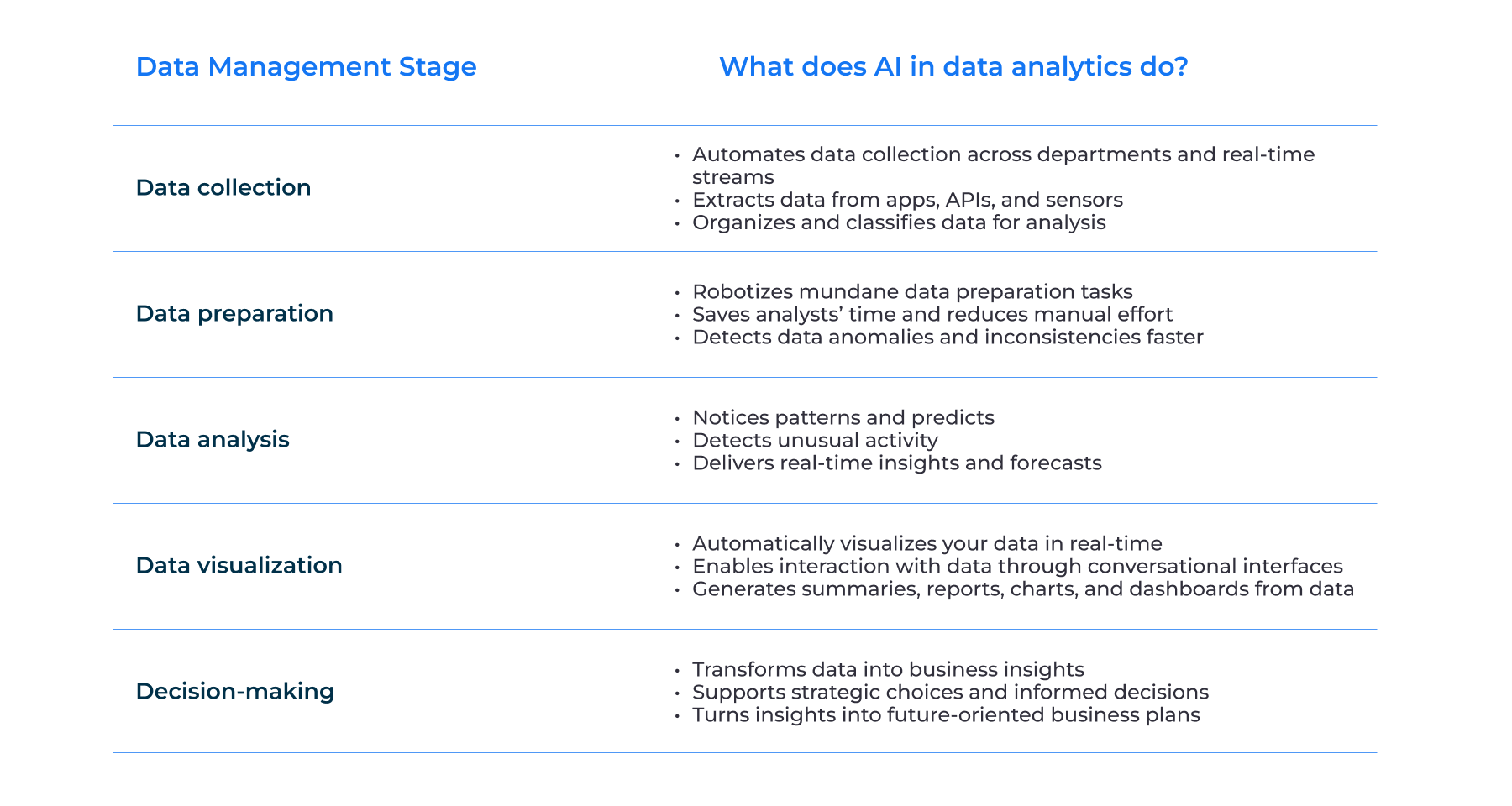
How many times do you need to gather information from different sources? And doing this manually takes time and effort and can also lead to mistakes. With generative AI, you hit a jackpot as you don’t need to build custom pipelines for each source of data. Intelligent, automated systems can not only pull data from apps, APIs, and sensors but also classify them for further processing and analysis.
If you deal with large datasets, you can be sure that AI in data analytics will manage them more productively than your analysts with traditional instruments. This particularly works for enterprises that collect data from multiple departments or real-time streams.
Data preparation
According to Gartner, data management tools based on ML algorithms can completely automate certain mundane data preparation tasks, thereby compressing the time to deliver insights. And that’s true, as traditional data management systems can help only partially.
AI in data analytics is worth its weight in gold for analysts who can’t find data anomalies and inconsistencies as fast as artificial intelligence. AI can automate routine tasks you need to prepare your data — joining datasets, standardizing labels, or formatting fields. So, no doubt, you’ll get higher-quality data for reporting and insights, reducing employees' workload.
Data analysis
Statistical analysis can be tough when your data is flawed and spread out among systems. Of course, it will take a while if you start extracting them from different sources and processing them. Plus, you can’t be sure your data analysts can identify meaningful patterns in complex datasets.
AI analytics does a good job of data analysis, as it can detect patterns, forecast outcomes, and spot unusual behavior. Plus, as AI models can run nonstop, you can receive analysis and predictive analytics in real-time. So, see, the problem with delayed reports can be solved.
Data visualization
AI in data reinforces the power of data visualization tools, transforming them into real-time dashboards with insights that might escape the human eye, according to researchers in Frontiers in Bioinformatics. As ML algorithms and NLP are the basis of AI data analytics, you can both visualize and interact with your data through conversational interfaces.
So no matter what you need: summaries, reports, charts, or dashboards based on your data, you’ll get them swiftly. Enterprise-grade businesses with tons of data benefit from AI, which automates data visualization and speeds decision-making.
Decision-making
Do you base all your decisions on data and insights derived from them? The bitter truth is that you have a poor data management strategy if you can’t make strategic choices using findings from your datasets.
Modern AI solutions contribute to problem-solving, moving your team from insights in your datasets to informed decisions and, ultimately, to future-oriented plans. And the advantage of this approach is that it helps spot issues, forecast risks, and transform signals like customer emotions or behaviors into patterns to act on.
It’s clear that AI in data analytics is a powerful tool at every stage of data management, speeding up and improving data workflows. Plus, with advanced analytics, businesses can gain more value from the continuous flow of raw data from multiple sources in real time.
How Businesses Use AI Analytics with Intellectsoft
As you can see, AI can accompany every stage of data management, helping companies handle their data with more benefits for their decision-making and problem-solving processes. But let’s review real-life examples of how we help our clients integrate AI data analytics into their workflows and how this impacts their returns.
Pattern recognition and outcome prediction
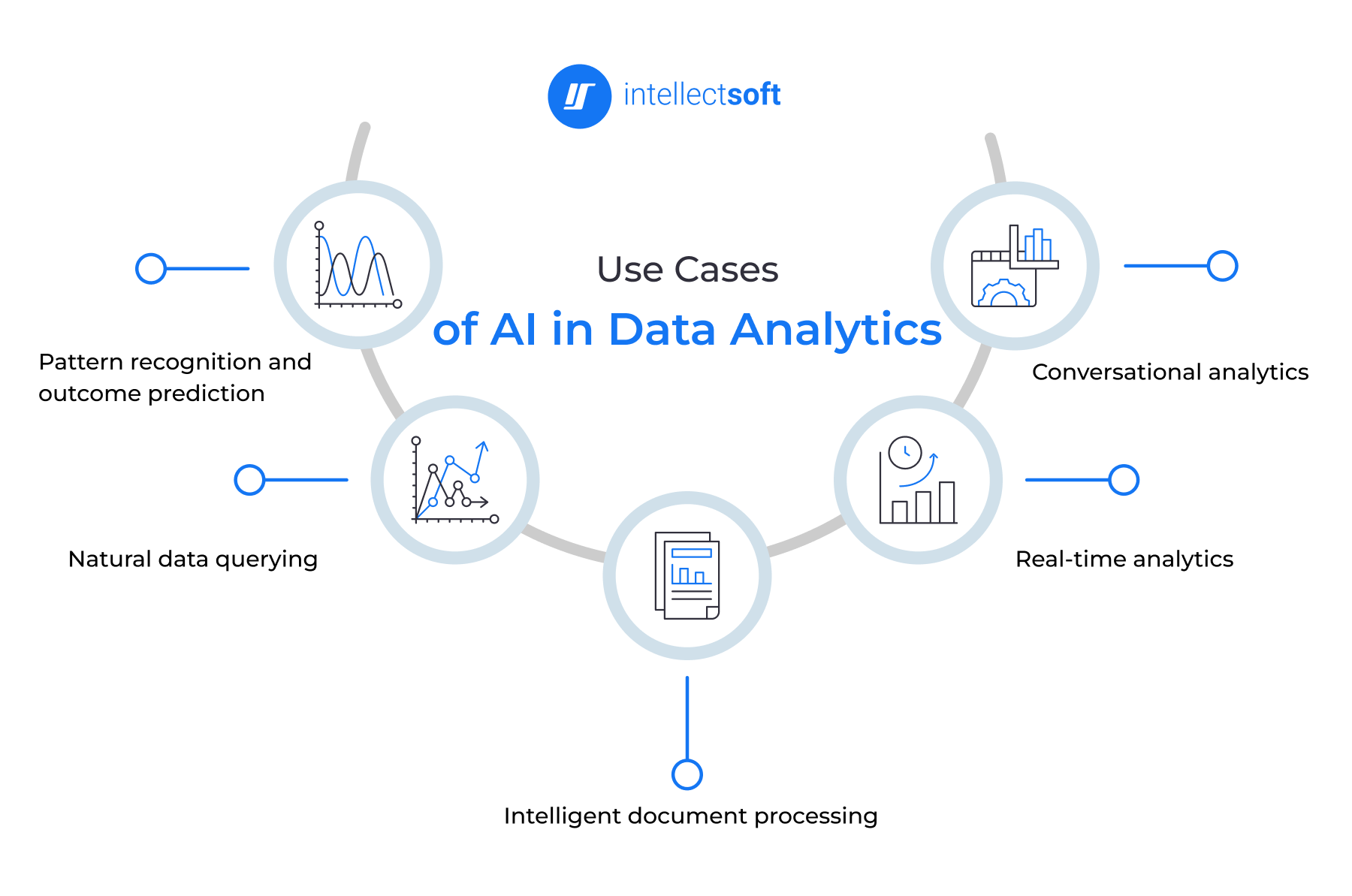
One of the core functions of AI data analytics is to process large amounts of historical and real-time data to recognize patterns and make predictions used to make strategic choices. So with findings from your datasets, you can better visualize your future and act more confidently.
We have an on-point story to share when we helped a global pharmaceutical company build an AI engagement platform powered by Databricks. The solution analyzes customer data and interaction history to recommend the best timing, content, and communication channels – all to personalize outreach and increase engagement.
Natural language data querying
AI in data analytics transforms natural language querying (NLQ), making it easier and more available for business users. Instead of writing SQL queries or writing your requests through dashboards, they can ask, “What were our top-selling products last quarter? They can get clear insights in seconds. So AI makes analytics more user-friendly for nontechnical teams.
For example, we developed an AI-powered internal analytics function for an enterprise. It enabled analysts to submit requests and instantly receive insights without developers’ assistance. The solution automates query generation and execution, reducing developer workload by 60–70% and speeding data access and decision-making by 3–5x.
Intelligent document processing
Another application of AI data analytics is intelligent document processing. Instead of entering data and interpreting them manually, you can do this automatically, so you can get structured and fact-based insights in seconds.
For a US-based healthcare clinic, we built an AI-backed document processing system to help them process lab reports, extract and verify structured data, and identify patterns faster and more efficiently. As a result, the clinic reduced manual data entry work by up to 70% and sped up document processing by 4x.
Conversational analytics
Conversational analytics is another application of AI in data. As many businesses have data scattered across multiple sources, NLP or NLQ enables swift access to data. As we mentioned in the previous case study, employees can simply ask questions in natural language querying and receive clear insights in seconds. As a result, they don’t depend on developers or analysts to retrieve information.
One of our clients, a U.S. enterprise, came to Intellectsoft to automate data retrieval and validation. Our team has developed a conversational analytics platform that contributes to more efficient data management. The company has reduced the time to extract insights by up to 80% and made decision-making 3x faster.
Real-time analytics
Live analysis is accessing and processing data in real time. How can you do this? Of course, with AI, you don’t need to analyze large data sets from different sources and make reports manually. Advanced analytics is the backbone of accurate insights and more informed decisions, made with minimal effort.
Here we can again remember our success story when we built a conversational analytics platform powered by RAG (Retrieval Augmented Generation) for a U.S. enterprise. As their data sources, such as SQL tables, documents, spreadsheets, and video transcripts, were disconnected, their employees had problems accessing data when they needed it. That’s why our solution enabled employees to work directly with live business data.
All these use cases of AI data analytics prove that businesses strive to simplify how they work with their data, they want and need to rely on their historical and current datasets, and make more informed decisions. Plus, companies understand how vital it is to take the load off teams and delegate tasks to AI that can automate them.
AI Tools That Support Data Analytics Workflows
The right technology stack is the backbone of AI in data analytics. That’s why, in addition to their needs, businesses should choose relevant analytics tools to automate data processing, analyze big data, generate predictions, and access insights through NLQ. Let’s review what instruments advance modern data analytics!
AI platforms for conversational analytics
According to McKinsey, more than half of mid-sized and large enterprises plan to pilot or expand conversational analytics and NQL interfaces as part of initiatives to democratize data access. This is the reason why businesses opt for such AI analytics tools:
- ThoughtSpot: An agentic analytics platform for enterprises that enables them to explore their data, ask questions, and extract insights from their business data swiftly at every stage of decision-making.
- Supaboard: AI-backed BI platform with which you can analyze data and produce interactive dashboards without hiring a data analyst. You can place your question and get real-time data insights and visual charts.
AI-powered BI and visualization tools
To become more intelligent and advanced, traditional BI platforms are integrating AI capabilities. Why do they practice this? First, they want to detect hidden patterns and extract insights. Second, they strive to speed up reporting, doing so in real time. Here are some examples of AI BI platforms:
- Microsoft Power BI: An interactive data visualization software based on AI copilots that can help you accelerate creating dashboards and reports and analyze trends using your data.
- Tableau: An integrated platform with smart visualization features and built-in Salesforce AI, so you can derive insights from your datasets and visualize them swiftly in real-time.
AI instruments for spreadsheet and file analytics
Intelligent document processing helps businesses swiftly analyze files, clean datasets, and generate insights without involving tech experts.
- Julius AI: This analytics tool manages Excel files, creates slide decks, and cuts down the time of your work on your datasets.
- Quadratic AI: An AI spreadsheet app that helps not only process data but also allows users to interact with data through NLQ.
Enterprise AI and machine learning platforms
To take most of the historical and current data, make accurate forecasts, and deploy AI analytics within their complex systems, businesses may need the following enterprise AI and ML platforms.
- Databricks: A data platform powered by AI that organizes data, automates analytics, and develops smart and efficient workflows around your data.
- Google Cloud Vertex AI and BigQuery ML: These ML platforms work seamlessly together, enabling a smooth integration between data warehousing and advanced AI.
Of course, with all these AI instruments, you can benefit more from your data analytics. And if you need assistance with AI integration, you can opt for our AI services and solutions.
What Returns AI in Data Analytics Can Deliver
Now it’s high time to summarize what piece of the pie you can expect if you power your data analytics with AI. No doubt, all the benefits of using AI for data analytics are related to making your business more flexible, efficient, and productive.
- Superior insight quality: You need not only to accumulate tons of data but also to extract reliable and actionable takeaways from it. Data analysis with AI provides you with more meaningful and accurate insights by cutting down the processing time through automation.
- Centralized data access: As your data is scattered across multiple sources, AI can connect them into a unified analytics infrastructure. So you can access, analyze, and manage your data in a more convenient way for your team.
- Precise business forecasts: Using both your historical and current data on user behaviors and trends, AI analytics can make predictions that can assist you with strategic planning and making important decisions for your business.
- Work with data instantly: With advanced analytics, you can analyze your data in real time, access findings without delays, and make more informed decisions according to patterns you detect.
- Revealing hidden insights: The human eye can’t notice everything, unlike AI. That’s why AI analytics is a great source of valuable insights extracted from your past and current data.
With these returns from AI analytics, you can get most of your data, operate more efficiently, notice possible risks, and make confident choices.
Limitations of AI in Data Analytics and How Intellectsoft Solves Them
It’s important to realize that advanced analytics can be complex for businesses, especially when their data is of poor quality, and they do not use transparent AI models. Add here data management risks and privacy concerns, and the desire to power your data with AI can come and go. That’s why, as experts in AI, we want to share obstacles on the way and how we deal with them.
Poor data quality and biased results → Building centralized data environment
If your datasets are scattered across systems and are in different formats, you can’t expect that AI-generated insights from them are accurate and reliable. The quality of work of generative AI models depends strongly on the data they process.
How to fix this? At Intellectsoft, we build centralized data systems that transform raw information into organized and consistent data before AI models process it. Plus, we can automate data quality monitoring to detect anomalies in real-time.
Lack of transparency in AI models → Development of explainable AI workflows
You can run into some trouble because some AI systems operate like black boxes. So it's not strange that it’s difficult to understand how they generate predictions and conclusions. Hence, the lack of clarity leads to uncertainty and concerns over extracted insights.
Our AI team develops explainable AI workflows with transparent logic, traceable analytics, and clear reporting mechanisms. So it isn’t a problem for you to observe the flow of your insights.
Overreliance on AI-generated insights → AI systems that combine automation with human control
If you rely entirely on automation, this can lead you to inaccurate findings and risky choices. But indeed, you should also consider the business context and involve human judgment.
In this case, we build AI-backed systems with automation features and human control. As a result, your analysts and business teams can improve models, validate outputs, and keep control over strategic decisions.
Data governance and compliance issues → Building governed AI analytics infrastructure
As AI analytics systems are changing, you need to control whether they meet compliance requirements. Otherwise, you will have legal issues that can damage your reputation.
This is one of the reasons why we care about compliance with your system. With domain-specific rules in mind, we build a governed AI analytics infrastructure that is flexible and supports long-term upgrades.
Privacy and security risks
You should remember that one of your vulnerabilities is privacy and security risks as your AI analytics platform processes sensitive business and customer data. So you should think about how to protect them.
To ensure responsible and secure AI usage and protect sensitive information, we implement enterprise-grade security practices, controlled access policies, and encrypted data pipelines.
Planning to Integrate Advanced Analytics? Work with Our Team
If you’re thinking about supporting your data management with AI, consider the Intrellectsoft team. You may ask, “What makes you different from rivals?”
- Robust and reliable AI solutions: We start with architecture and system design first, helping you scale up, add more integrations, and grow your system.
- Faster delivery with consistent communication: With teams in Eastern Europe, LatAm, and APAC, we ensure ongoing development, faster timelines, and seamless collaboration for complex AI projects.
- Enterprise expertise with flexible partnership: You get access to senior AI, cloud, data, and architecture experts while still getting responsive and personalized assistance.
- AI products aligned with business needs: We help you build AI solutions that not only function technically but also support user needs and contribute to long-term business value.
Ready to integrate generative AI into your data analytics? We deliver AI services and solutions that help you use data to improve business performance.
FAQ
How does AI help understand your data?
AI algorithms help recognize patterns and detect anomalies in data. So you can not only present the results but also reveal the causes.
Can AI simplify analytics for non-technical users?
AI removes the need for complex queries or manual dashboard creation. Users can ask questions in plain language and receive instant answers or visualizations.
What benefits do companies receive when using AI in analytics?
Swift generation of insights
Increase in the clarity of findings
More fact-based strategic decisions
